Charles Mix County Dog Registration Information
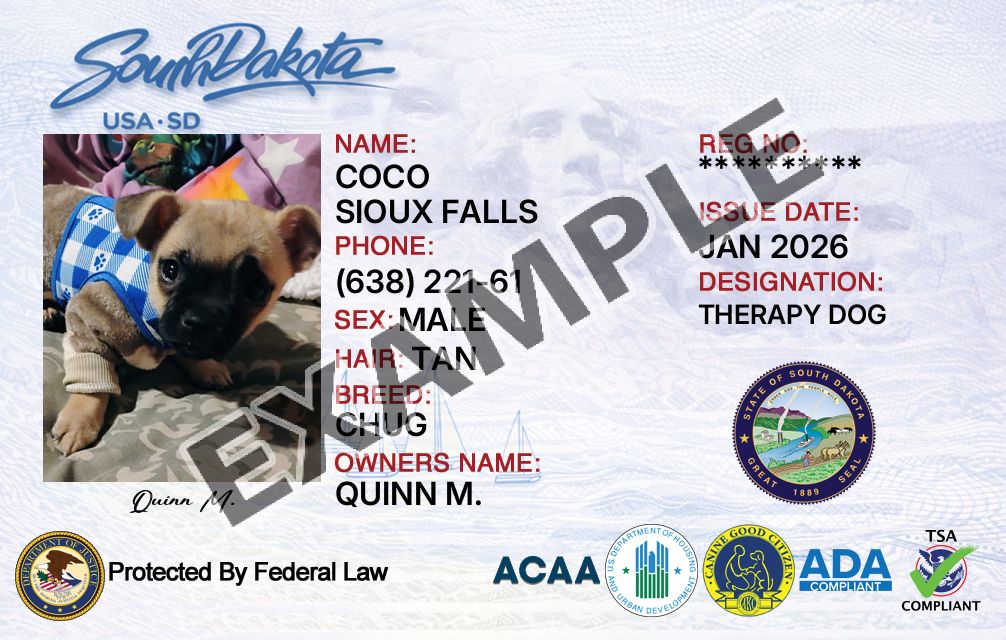
Service Dogs and Emotional Support Animals in Charles Mix, South Dakota
Registering a Dog in Charles Mix County, South Dakota (Service Dog or Emotional Support Animal)
If you’re searching where do I register my dog in Charles Mix County, South Dakota for my service dog or emotional support dog, the key thing to know is that “registration” can mean different things. Most residents are actually looking for a dog license in Charles Mix County, South Dakota (a local tag/license tied to rabies compliance), while service dog and emotional support animal (ESA) status are governed by different rules and are not created by buying an online certificate.
Where to Register or License Your Dog in Charles Mix County, South Dakota
Because licensing is often handled locally, below are example official offices within Charles Mix County that residents commonly contact for dog licensing direction, animal control questions, and local ordinance enforcement. Details are listed only when publicly available from official sources; if a detail is not available, it is not shown.
Charles Mix County Courthouse (Main County Office)
400 Main Street
Lake Andes, SD 57356
Charles Mix County Sheriff’s Office
215 S 6th St
Lake Andes, SD 57356
City of Wagner (City Office)
PO Box 40
60 Main Ave SE
Wagner, SD 57380
Town of Pickstown (City Office)
218 White Swan Drive
Pickstown, SD 57367
Not sure which office applies to you?
Charles Mix County includes multiple municipalities (for example, Lake Andes, Platte, Wagner, Pickstown, and others). If you live inside city limits, licensing is often handled by that city office. If you live outside city limits (unincorporated county areas), ask the county courthouse where to go for the correct local process in your area.
Overview of Dog Licensing in Charles Mix County, South Dakota
What “dog registration” usually means
When people ask where to register a dog in Charles Mix County, South Dakota, they’re typically referring to a local dog license (sometimes called a “dog tag” or “pet license”). A license is generally a local requirement intended to:
- Encourage rabies vaccination compliance and improve public health tracking.
- Help identify a dog if it becomes lost.
- Support local enforcement of leash, nuisance, and at-large ordinances.
Most licensing is handled locally (city/town first)
South Dakota dog licensing requirements are commonly set and enforced by local ordinances. That means the answer to “where do I register my dog” depends on whether your address is inside a city (such as Wagner or Pickstown) or in the county outside city limits. If you are inside city limits, the city finance office/city hall is often the place to start.
Rabies vaccination expectations
In most communities, a current rabies vaccination is a practical prerequisite to licensing. You’ll typically be asked to show proof (often a rabies certificate from your veterinarian). If your dog is involved in a bite incident, rabies documentation can also affect quarantine steps and reporting requirements.
How Dog Licensing Works Locally in Charles Mix County, South Dakota
Step 1: Identify the correct jurisdiction (city limits vs. county)
Start by confirming where you live:
If you live inside city limits
Contact your city office (often the finance office/city hall). Ask what the current licensing period is (annual vs. multi-year), what proof is required, and whether the tag must be attached to the collar.
If you live outside city limits (unincorporated county)
Call the county courthouse main line to ask where dog licensing or rabies enforcement is handled for your specific address. In some areas, enforcement questions may be routed through the sheriff’s office or other designated local authority depending on the situation.
Step 2: Prepare your documents
While the exact requirements vary by locality, most dog licensing processes revolve around verifying ownership and public health basics. Many offices will ask for rabies vaccination proof, and some communities may have different fees or conditions based on spay/neuter status or the number of dogs at a residence.
Step 3: Apply, pay the local fee, and keep the tag/proof
After you apply and pay, the office may issue a tag and/or a receipt. Keep a copy of the license record with your important pet documents. If your dog is ever found running at large, the tag can speed up reunification and reduce the chance of penalties.
What to do if you’re being told to “register” a service dog or ESA
Be cautious with wording. You may still need a dog license in Charles Mix County, South Dakota for your animal even if it is a service dog or an ESA. But service dog status is not created by buying a registration online, and ESA status is not the same as a public-access service animal. The sections below break down the differences so you know exactly what to ask for at the local office.
Service Dog Laws in Charles Mix County, South Dakota
A dog license vs. service dog status
A local dog license is about local animal rules (tags, rabies verification, and ordinances). A service dog, by contrast, is defined by what the dog is trained to do for a person with a disability. Service dog status comes from meeting legal definitions and training expectations—not from paying for an online “service dog registry.”
Public access: what matters in real life
In typical public settings, the core issue is whether the dog is a legitimate service animal trained to perform specific tasks related to a disability and whether the dog is under control and housebroken. Even if a business or landlord doesn’t ask for a “license,” you should still expect your community’s local licensing rules to apply.
Do service dogs need a local license?
Often, yes. Many local jurisdictions require licensing for dogs kept in their community. If you’re asking where do I register my dog in Charles Mix County, South Dakota for my service dog, you’re usually looking for the same local licensing office that issues standard dog tags—plus you may want to ask if any local fee waivers or special tag options exist (availability varies by community).
Avoid third-party “registrations”
A paid online registration card is not a substitute for training, does not replace local licensing, and does not change the legal definition of a service animal. If an office asks for documentation, clarify exactly what they mean (rabies certificate, proof of licensing, etc.) rather than relying on third-party paperwork.
Emotional Support Animal Rules in Charles Mix County, South Dakota
ESA vs. service dog: the practical difference
An emotional support animal (ESA) provides comfort by its presence, but it is not the same as a trained service dog that performs tasks. This difference matters because:
- Dog licensing: ESAs are typically still subject to the same local dog licensing requirements and rabies expectations as other dogs.
- Public access: ESAs generally do not have the same public-access rules as service dogs in typical retail/dining environments.
- Housing: ESA-related rights are most commonly discussed in the context of housing accommodations, which is separate from licensing.
Do you “register” an ESA with the county?
Usually, no. If you’re searching where do I register my dog in Charles Mix County, South Dakota for my emotional support dog, what you likely need is:
1) Local dog license (city/county, depending on where you live)
Contact your city office (if you are within city limits) or ask the county courthouse where licensing is handled for your location.
2) Separate ESA documentation for housing, if applicable
If you are seeking an accommodation related to housing, follow the rules applicable to housing providers. This is separate from dog licensing and does not replace rabies or local ordinance compliance.
Why local offices may still ask for rabies proof
Regardless of whether your dog is a pet, an ESA, or a service dog, rabies vaccination documentation is often the most important health-related record for local licensing and for responding to bite incidents. Keeping your proof current helps avoid delays.
Frequently Asked Questions
Register A Dog In Other South Dakota Counties
Select your county below to get started with your dog’s ID card. Requirements and license designs may vary by county, so choose your location to see the correct options and complete your pup’s registration.
- Aurora County Dog Registration
- Beadle County Dog Registration
- Bennett County Dog Registration
- Bon Homme County Dog Registration
- Brookings County Dog Registration
- Brown County Dog Registration
- Brule County Dog Registration
- Buffalo County Dog Registration
- Butte County Dog Registration
- Campbell County Dog Registration
- Clark County Dog Registration
- Clay County Dog Registration
- Codington County Dog Registration
- Corson County Dog Registration
- Custer County Dog Registration
- Davison County Dog Registration
- Day County Dog Registration
- Deuel County Dog Registration
- Dewey County Dog Registration
- Douglas County Dog Registration
- Edmunds County Dog Registration
- Fall River County Dog Registration
- Faulk County Dog Registration
- Grant County Dog Registration
- Gregory County Dog Registration
- Haakon County Dog Registration
- Hamlin County Dog Registration
- Hand County Dog Registration
- Hanson County Dog Registration
- Harding County Dog Registration
- Hughes County Dog Registration
- Hutchinson County Dog Registration
- Hyde County Dog Registration
- Jackson County Dog Registration
- Jerauld County Dog Registration
- Jones County Dog Registration
- Kingsbury County Dog Registration
- Lake County Dog Registration
- Lawrence County Dog Registration
- Lincoln County Dog Registration
- Lyman County Dog Registration
- Marshall County Dog Registration
- McCook County Dog Registration
- McPherson County Dog Registration
- Meade County Dog Registration
- Mellette County Dog Registration
- Miner County Dog Registration
- Minnehaha County Dog Registration
- Moody County Dog Registration
- Oglala Lakota County Dog Registration
- Pennington County Dog Registration
- Perkins County Dog Registration
- Potter County Dog Registration
- Roberts County Dog Registration
- Sanborn County Dog Registration
- Spink County Dog Registration
- Stanley County Dog Registration
- Sully County Dog Registration
- Todd County Dog Registration
- Tripp County Dog Registration
- Turner County Dog Registration
- Union County Dog Registration
- Walworth County Dog Registration
- Yankton County Dog Registration
- Ziebach County Dog Registration